
Spotlight · Ruth Biney Senior · STEM Research Fellowship
Ampe-DB: When a Ghanaian Game Becomes Research Data
Ruth Biney Senior is documenting the movement, rhythm and interaction of Ampe in a form that computers can study.
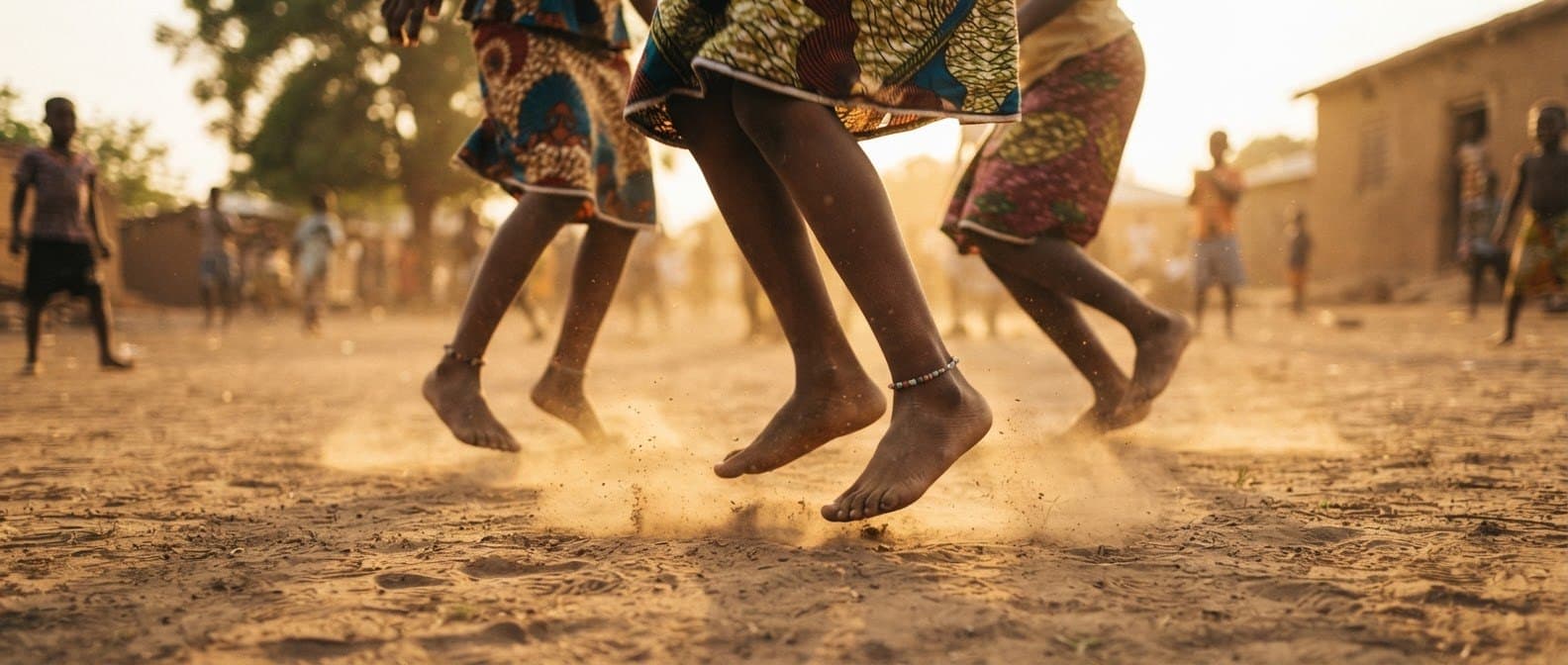
Two players face one another. They jump at the same time, clap, land and put one foot forward. A point can turn on something that happens in less than a second: which leg each player chooses, how quickly they respond, and whether one player anticipates the other correctly.
That is Ampe.
Ampe is a Ghanaian jumping and clapping game widely associated today with girls and school playgrounds, but its social history is older and broader. Historical research records organised Ampe competitions involving women in the early twentieth-century Gold Coast. The game requires almost nothing to play: no ball, no board and no equipment. What it does require is timing, rhythm, observation and another person.
For YARA Fellow Ruth Biney Senior, those characteristics make Ampe more than a cultural practice worth documenting. They make it an unusually interesting research problem.
What does a computer see when two people play Ampe?
Many movement datasets reduce a person to a sequence of positions: a body walking, running, dancing or performing a defined action. Ampe is different. The movement of one player only makes sense in relation to the movement of the other.
Two people jump together. They respond to one another. Their actions have rhythm. They make split-second choices. The outcome of an exchange depends on what both players do.
Ruth’s work asks whether that interaction can be represented computationally. The result is the Ampe Movement Dataset, or Ampe-DB.
Ampe-DB records paired gameplay using several forms of information at once: RGB video captures visible movement; audio records claps, steps and other timing cues; 2D pose data converts the players’ bodies into skeletal keypoints; and annotations describe movement segments, synchronisation and round outcomes.
Together, those layers make Ampe-DB a multimodal human-movement dataset. Researchers can begin to ask how closely two people are synchronised, whether a model can recognise stages of an exchange, whether movement early in a round can help predict what happens next, and how two people change their movements in response to each other.
Why Ampe matters as data
The data available to researchers affects the questions they are able to study. Ampe-DB starts from a Ghanaian cultural practice and makes it possible to study human movement, interaction, rhythm and machine perception from that starting point.
Its usefulness does not have to end with Ampe. Methods for representing pose, timing and coordination are relevant to wider research in human movement. Those methods can contribute to work in rehabilitation and biomechanics, where researchers study movement and recovery, and in robotics, where machines increasingly need to observe human motion, anticipate what a person may do next and coordinate safely around people.
Ampe-DB itself is not a medical or robotics dataset. Its contribution is more fundamental: it gives researchers another setting in which to study paired, anticipatory human movement, where one person’s action is continuously shaped by another person’s movement.
A cultural game becomes a research instrument
Documenting Ampe computationally also creates a record of a cultural practice in a form that can be examined, reused and extended by future researchers.
Turning culture into data creates responsibilities. Ampe-DB is intended for research, education and approved non-commercial use. Its documentation prohibits surveillance, biometric identification and individual profiling, and access to the underlying data is managed through a usage agreement.
Preserving a cultural practice as data should not mean stripping it of the people, history or context from which it came.
For Ruth, Ampe-DB begins with a Ghanaian game. The research question around it is larger: what can we learn about human movement and interaction when the datasets used to study them begin to include more of the ways people actually move, play and relate to one another?